Dreambaby sent us the products mentioned here at no cost. No payment was involved.
The Consumer Product Safety Commission recommends 13 childproofing measures, including anchoring furniture and TVs, setting the water heater to 120 degrees Fahrenheit or lower, installing safety gates and window guards, using cordless window coverings, and placing smoke alarms on every level and inside each bedroom with carbon monoxide alarms outside sleeping areas.
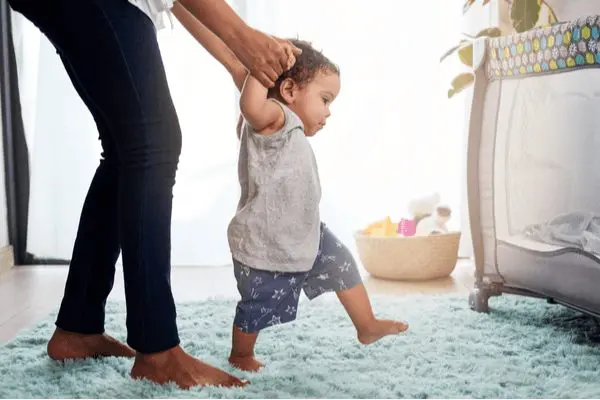
Your baby will be mobile before you feel ready, and the whole house changes character the week she starts pulling up. The good news is that childproofing is a finite list. You do it once, mostly with hardware, and then you are done.
The Consumer Product Safety Commission publishes the list. Here it is, sorted by where you will actually be standing.
Start with the two that cost nothing
Turn down the water heater. CPSC says to set it to 120 degrees Fahrenheit or lower, or install anti-scald devices. Tap water hotter than that can burn a small child in seconds. This takes five minutes and one trip to the basement.
Check your alarms. CPSC calls for smoke alarms on every level of your home and inside each bedroom, and carbon monoxide alarms outside of bedrooms near each sleeping area. Test them, and write the battery date on the casing.
The nursery
CPSC’s first recommendation is to use infant sleep products that meet its mandatory standards — a crib, bassinet, portable crib or play yard. Alternative products like inclined sleepers and pods only qualify if they comply with the federal safety standards that took effect in June 2021.
Then anchor. Furniture and television tip-overs are on CPSC’s list, and a dresser a toddler can climb is a dresser that can come down on her. Anchor the dresser, the bookcase and the TV.
And go cordless on the window coverings. CPSC names cordless window coverings specifically, because a looped cord at crib height is a strangulation hazard.
The kitchen and bathroom
Safety latches and locks on the cabinets and drawers that hold anything hazardous — cleaners, medications, knives, dishwasher pods. CPSC puts these on the list, and the point is not to make the cabinet impossible, just slow.
If you would rather not buy latches, stops and covers piece by piece, Dreambaby’s No Tools, No Screws Safety Value Pack bundles them in one box and installs without a drill.
Door knob covers and locks control which rooms she can get into at all. Use them on the bathroom if you cannot supervise it, since standing water is a drowning risk at any depth.
In the bath, check the water temperature before she goes in. A bath thermometer takes the guesswork out, and Dreambaby makes inexpensive ones shaped like animals that double as a tub toy.
Stairs, doorways and edges
Safety gates are on CPSC’s list to prevent falls and to keep a child out of rooms that are not ready for her. At the top of a staircase, use a hardware-mounted gate, not a pressure-mounted one.
Dreambaby’s Newport Adapta-Gate is one that handles irregular openings, which matters if your stairwell is not a clean rectangle. Whatever brand you buy, check that it is the hardware-mounted kind for the top of stairs.
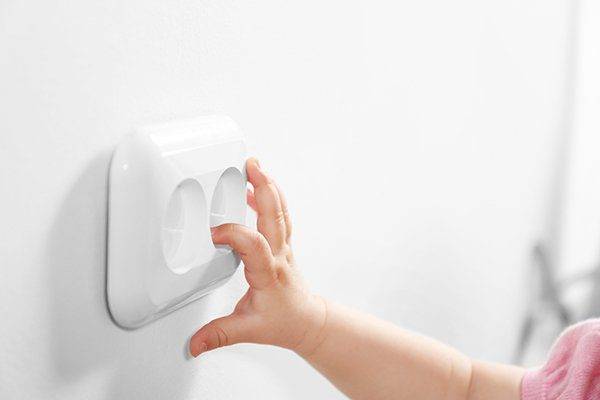
Corner and edge bumpers cushion the coffee table and the hearth. Outlet covers go everywhere she can reach.
Windows, balconies and water
Window guards and safety netting prevent falls from windows and balconies. A screen is not a guard — it is designed to keep bugs out, not to hold a child in.
If you have a pool, CPSC recommends layers of protection rather than any single barrier: fencing and gates, alarms, and covers together.
What’s normal, and when to call
Normal: a baby who climbs everything by fourteen months, bumps and bruises on shins and foreheads, and a house that looks less like a magazine for about three years.
Call your pediatrician, or 911, if:
- Your child has any fall from a height, hits her head and then vomits, is unusually sleepy, will not be consoled, or is not acting like herself. Same-day call.
- She may have swallowed a button battery or a magnet. This is an emergency room trip, not a wait-and-see. Button batteries can burn through tissue in hours.
- She may have swallowed any medication or cleaning product. Call Poison Control at 1-800-222-1222 immediately, and keep that number on the fridge.
- She had any submersion in water, even brief, and is coughing afterward.
Common Questions
When should I start childproofing?
Before she crawls, not after. Most parents aim for the six-month mark, which leaves time to install things before they are needed.
Do I need to childproof the whole house at once?
No. Do the rooms she is in daily first, and use door knob covers to close off the rest until you get to them.
Pressure-mounted or hardware-mounted gates?
Hardware-mounted at the top of any staircase. Pressure-mounted is fine for doorways and the bottom of stairs.
Are outlet covers enough?
The plug-in caps work, but they become choking hazards themselves if a toddler pries one out. Sliding outlet covers that replace the faceplate are sturdier.
What about grandparents’ houses?
Bring a travel kit — a few outlet covers, a couple of cabinet latches and a portable gate. Also check that their safety basics are in place before an overnight.
Sources
- U.S. Consumer Product Safety Commission, “Childproofing Your Home”
- Dreambaby, Newport Adapta-Gate product page
Getting the house ready? The health essentials checklist pairs with this one, and safety brands demo their gear in person at every Babypalooza Baby Expo.