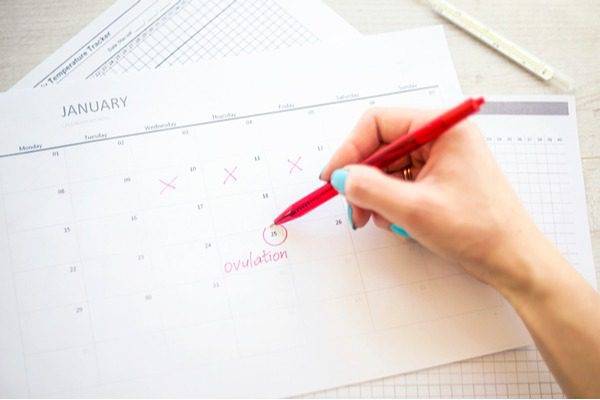


Ovulation is the few days a month when getting pregnant is actually possible, and your body gives you signs it is coming. The most useful one is cervical mucus. The most misunderstood one is your temperature. And the biggest mistake is waiting for a positive test before you start trying — by then, the best days are already behind you.
Here is how to read your own cycle.
What Ovulation Is, and When It Happens
Ovulation is the release of an egg from one of your ovaries. It happens once per cycle, and it is the thing everything else is timed around.
It is not day 14, and it is not a fixed calendar date. ACOG puts it this way: in an average 28-day cycle, ovulation happens about 14 days before the start of your next period. The stretch from ovulation to your period is the most consistent part of your cycle — the part that varies is the stretch before it. So if your cycle runs 35 days, you are likely ovulating closer to day 21. If it runs 21 days, closer to day 7.
That is why counting forward from your last period so often misses.
Your Fertile Window Is About Six Days
An egg can be fertilized for about 12 to 24 hours after it is released. Sperm last much longer — about three days inside your body, sometimes up to five.
Add those together and you get the window ACOG describes: you can get pregnant from about five days before ovulation until about one day after. The Office on Women’s Health calls it about six days per cycle.
The days before ovulation are the ones that count most. That single fact changes how you read every sign below.
Sign 1: Cervical Mucus
This is the one to learn first.
Across your cycle, the mucus your cervix makes changes. ACOG describes it plainly: just before ovulation the amount noticeably increases and it becomes thin and slippery. Just after ovulation, it decreases and turns thicker and less noticeable. The Office on Women’s Health describes peak-fertility mucus as clear and slippery, like raw egg whites.
ACOG considers monitoring cervical mucus the most reliable sign you can observe on your own, and says it peaks one to two days before ovulation — right inside your best days.
A few things can make it unreadable: medications, douching, feminine hygiene products, intercourse, breastfeeding, and a pelvic exam where lubricant was used.
Sign 2: Basal Body Temperature
Your basal body temperature is your temperature at rest, taken first thing in the morning before you get up, eat, drink or move around much. After you ovulate, it rises slightly — roughly half a degree Fahrenheit — and stays up.
Here is the part that gets misread, and ACOG says it directly: basal body temperature shows only when ovulation has already occurred, not when it is going to occur. Used by itself, it is not a good way to promote or prevent pregnancy.
That does not make it useless. Tracked over a few months, it shows you your own pattern, so you can anticipate next cycle. Just do not treat this month’s temperature rise as a starting gun. The most fertile days were the two or three days before it.
Sign 3: Cervical Position — Optional, and Less Solid Than It Sounds
You may read that your cervix is soft, high, open and wet around ovulation, and firmer, lower and closed otherwise.
Being straight with you: this is not described as a tracking method by ACOG, the CDC, the Office on Women’s Health, MedlinePlus, Mayo Clinic or Cleveland Clinic. The support for it comes from natural-family-planning research in 1962 and 1988. In the earlier study, only about half the women taught to self-examine could recognize the change, and the author listed subjective bias and unclear endpoints as limitations.
If you already use it alongside mucus tracking and it works for you, keep going. If you are just starting, put your effort into cervical mucus instead.
Other Things Some People Notice
These are real experiences, but none of them is reliable enough to time by.
- Ovulation pain (mittelschmerz). A one-sided ache or twinge around mid-cycle. Cleveland Clinic says it affects up to 40 percent of people who ovulate and usually lasts a few hours, occasionally up to two days.
- Light spotting.
- Tender breasts. More often a sign ovulation has passed than one it is coming.
- A noticeable rise in sex drive.
- Bloating or mood changes.
Cleveland Clinic lists these as common ovulation symptoms. ACOG, the CDC and the Office on Women’s Health do not include them among tracking methods at all — so treat them as confirmation of a picture you built from mucus, not as the picture itself.
Ovulation Predictor Kits
These are the urine tests you buy at the drugstore. They measure luteinizing hormone, and what they catch is the LH surge that happens about a day to a day and a half before you ovulate. A positive usually means ovulation in the next 24 to 36 hours.
Two things worth knowing before you rely on one.
The accuracy number on the box is not what you think. The FDA says these tests detect the hormone reliably about nine times out of ten, that the result depends heavily on following the instructions, and that starting on the wrong cycle day makes the test unreliable. Manufacturer claims of “over 99% accurate” refer to detecting the hormone in a sample in a lab, not to predicting the day you personally ovulate.
A positive test is not the starting gun. The LH surge marks the end of your fertile window approaching, not the beginning. If you wait for a positive before having sex, you have already spent several of your best days. Use the kit to confirm what your mucus is telling you, and start earlier.
MedlinePlus notes a few other limits: you can miss a surge if you skip a day, false positives happen, a surge may be hard to detect with irregular cycles, and some medications shift LH levels.
Apps and Wearables
An app that predicts your fertile days from your cycle length is guessing, and it is not a good guess. Peer-reviewed testing found calendar-based app prediction of the ovulation day was no better than 21 percent accurate. The same research found that only 15 percent of women actually had a 28-day cycle, though 34 percent believed they did.
Wearables that read body signals do better than calendar math, but a 2026 review in npj Digital Medicine pooling 27 studies found accuracy around 0.88 for detecting ovulation within a two- to three-day window — useful, but still a window, not a day, and the authors concluded the technology is not yet ready to stand in for clinical fertility parameters.
Two practical notes. First, “FDA approved” is almost never the right description of a cycle app. A narrow set of software devices has been FDA-authorized, and that authorization is for contraception, not for pinpointing ovulation. Most period trackers are not FDA-cleared medical devices at all. Second, ACOG points out that free period-tracking apps are not covered by HIPAA.
Use an app to record what you observe. Do not let it tell you what is happening.
What’s Normal, and When to Call
Normal looks like this: regular periods, a stretch of slippery egg-white mucus once a cycle, and a temperature that rises after. The CDC says regular, predictable periods every 21 to 35 days likely reflect ovulation — and that a woman with irregular periods is likely not ovulating.
Call your provider if:
- Your periods are irregular or far apart. The Office on Women’s Health flags a cycle shorter than 24 days or longer than 38 days, or cycle length that swings by more than 20 days month to month.
- You have missed three periods in a row and are not pregnant or breastfeeding. Per the Office on Women’s Health, that can mean your ovaries are not making normal amounts of estrogen.
- You never see a positive on an ovulation test, or you have used kits for several months without a pregnancy. MedlinePlus says to raise both with your provider.
- Mid-cycle pain comes with a fever over 100.4°F, pain with urination, severe nausea or vomiting, pain that lasts more than a day or does not respond to over-the-counter medicine, or heavy bleeding between periods. Cleveland Clinic lists these as reasons to call rather than wait.
- You have been trying for 12 months and you are under 35, or 6 months and you are 35 or older. ACOG, ASRM, the CDC and NICHD all agree on those thresholds. If you are over 40, talk to your ob-gyn now rather than waiting out a clock.
Failure to ovulate is behind about 40 percent of female infertility, according to NICHD, and it is often treatable — PCOS, thyroid disease and hypothalamic causes all have paths forward. Not ovulating is a reason to get seen, not a reason to keep waiting.
Common Questions
How Do I Know for Sure That I Ovulated?
The clearest home sign is a sustained temperature rise after a stretch of slippery mucus. A blood progesterone test ordered by your provider confirms it directly. An ovulation predictor kit shows the hormone surge before ovulation, not the release itself.
Can I Ovulate and Still Have Irregular Periods?
You can, but irregular cycles often mean ovulation is not happening reliably. The CDC treats regular periods every 21 to 35 days as the likely sign of ovulation and irregular periods as a reason to be evaluated.
Is Cervical Mucus or an Ovulation Test More Useful?
Cervical mucus, for timing. ACOG calls it the most reliable sign you can observe yourself, and it peaks one to two days before ovulation — inside your best days. A test confirms; mucus gives you the head start.
What If My Cycle Isn’t 28 Days?
Then day 14 does not apply to you. Count back about 14 days from when your next period is due. A 35-day cycle puts ovulation nearer day 21; a 21-day cycle, nearer day 7.
Does Ovulation Pain Mean I’m Ovulating Right Then?
Not exactly. Cleveland Clinic describes mid-cycle pain as occurring around ovulation and affecting up to 40 percent of people who ovulate, but it is not precise enough to time intercourse by on its own.
Can Stress Stop Me From Ovulating?
Severe stress can. The CDC notes that functional hypothalamic amenorrhea — periods stopping without an organic cause — can be caused by excessive exercise, weight loss or stress. Ordinary week-to-week stress is a different thing, and there is no evidence it prevents pregnancy.
Trying to conceive?
How to get pregnant fast covers what to do once you know your window — and the next Babypalooza Baby Expo puts you in a room with providers who can answer the rest.